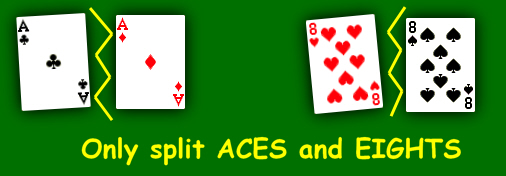
The reason that the game of blackjack is subject to mathematical analysis is because it is, inherently, a mathematical game; that is, blackjack has a fixed set of rules. CASINOS’ EDGE In Chapter 1, I showed you how you can reduce the casinos’ edge in blackjack to about 0.2–0.5% (rule dependent) by knowing the correct playing decisions (i. Always split aces. Never split tens. A pair of 9’s splits against dealer 2 through 9, except for 7, otherwise stand. Always split 8’s; A pair of 7’s splits against dealer 2 through 7, otherwise hit. A pair of 6’s splits against dealer 2 through 6, otherwise hit. A pair of 5’s doubles against dealer 2 through 9 otherwise hit. In blackjack, some pairs should never be split, or at least not if basic strategy is your only weapon in the battle against the casino. Such is the case with pairs of 5s and pairs of ten-value cards. When you start a round with a pair of 10s, you face two possible playing decisions – you either stand on your pat 20 or split the pair. How to Split in Blackjack: Rules The only condition when splitting is available is when you have a pair in the initial hand. You cannot split after a hit or any other move. Thus, if you get 6-6, and then another 6, you cannot split your hand. But there is also one more type of blackjack hand – hand where two cards are of the same rank. In this situation players should use the Strategy for Splitting Pairs. Here is presented the basic strategy when playing blackjack with a hand that consists of a pair. This is also called the splitting pairs strategy.
- Appendices
- Miscellaneous
- External Links
Blackjack Split Rules
Introduction
It is generally allowed to bet behind another player in blackjack. This is done by placing a bet behind that of the player with control of the hand. You see this often in crowded casinos, but it can happen anywhere. It is especially common on Macau.
When this happens, and the player in control splits, the back-player has the choice to match his original bet and play out both hands, or keep only his original wager on the table and play it out on the first of the split hands. This is a valuable option to have, as this appendix will show.
The first table below shows the number of hands the back-player should choose to play. This is based on infinite decks, and is the same regardless of whether the dealer hits or stands on a soft 17. It does assume that double after a split is allowed. It also includes obviously bad splits, which are included for the sake of completeness, rather than to imply that the player in control should split. The table also assumes that the front-player will keep resplitting, even if it is a bad play.
With a selfish player in control, splitting only when it is in his best interest, following the back-splitting strategy above will lower the house edge against the back-player by 0.08%.
The next table shall refer to an unselfish player, who will split or not split according to the benefit of the back-player. This could happen if the two players are in collusion, and the back bet is significantly larger than that of the acting player. The table shows when the acting player should split, assuming double after split is allowed and an infinite number of decks. It does not matter whether the dealer hits or stands on a soft 17.
Following this strategy the house edge of the back-player is reduced by 0.20%. Combining the benefit of both players, some kind of hybrid splitting strategy would be in order, according to the ratio of the back back to the front bet. This is an area for future addition to this page.
When To Split In Blackjack Chart
This topic is also addressed in chapter 6 of Basic Blackjack by Stanford Wong.