After the flop you usually won’t have much left in front as a short stack so when you hit top pair with a strong kicker you should be thinking about getting all your money into the pot. If you run into a better hand, that’s poker, especially short stack poker. When the money goes in there are almost always outs to make the winning hand. Short stack is defined by the number of big blinds your stack represents. For an online tourney that features 5,000 starting chips and an opening BB of 20, each player has 250 BBs to start with.
Short Stack Strategy (SSS), it’s one of those terms you will hear and read about a lot in the beginning of your poker career. It’s known to be one of the simplest poker strategies to play, but even more important, it’s one of the safest possible strategies to apply, hence very hard to beat for your opponents.
Because of its simplicity, applying this beginner poker strategy will help many players building up their initial bankroll. Most poker coaches will advice Short Stack Strategy for beginner No Limit Texas Hold’em players.
The Principles of Short Stack Strategy
First of all you should know that Short Stack Strategy can only be applied when playing full ring games with 7 players or more. As soon as a table reaches less than 7 players, you will have to get up and find yourself a new table to play at.
Another thing to watch out for is for players who also apply Short Stack Strategy to their games as well. Obvious, your winning changes will vanish the more players use this tactic when playing poker.
As I already mentioned before, playing the Short Stack Strategy is very simple. Once you’ve found a table that suits you, you will have to buy-in for the minimum table amount (which usually is 20 big blinds).
Now that you know this, you should not have any problems recognizing SSS players, as they will always buy-in for the minimum amount of money allowed at the table, just like you.
Since Short Stack Strategy is a very aggressive type of poker strategy, a rule of thumb is that you will never be calling. It’s either raise (including shoving all-in) or fold.
Things to Keep in Mind
- It only works with No Limit Hold’em
- Only sit down at full ring games with 7 or more players
- Always buy-in for the minimum table amount
- Only raise (all-in) or a fold (thus no calling)
- Only play premium poker hands in the right position
Pre-Flop Starting Hand Requirements for SSS
There’s a safer way of applying the Short Stack Strategy, using the starting hands suggested by PokerStrategy.com, or you can take a little more risk by using the starting hands Phill Hellmuth wrote about in one of his poker books.
Personally I’d recommend the following way, especially if you’re a beginner, and maybe play a somewhat wider range of starting hands once you seriously get the hang of it.
You can read a short description about both Short Stack Strategy methods below.
PokerStrategy.com recommends playing cards starting at pockets 7’s and up, but please take in account your position at the table and any actions players in front of you might have made.
SSS When Nobody has Opened
Raise any of the following hands:
- Early position JJ – AA, and AK
- Middle position 99 – AA, and AK AQ
- Late position 77 – AA, and AT AJ AQ AK KQ
Your default raise must be a raise of four times the big blind, including an extra big blind for every other poker player who has limped in.
SSS When Someone has Raised
Move all-in with any of the hands in the following situations:
- 1 raise ahead of you JJ – AA, and AK
- 2 or more raises ahead of you – KK AA
- when your opening gets re-raised – TT – AA, and AK
Short Stack Strategy Guide
Now, lets briefly talk about the more aggressive SSS approach Phill Hellmuth came up with. He basically tells you to shove all-in before the flop with any hand in the range of 22 to AA, plus AQ and better. The main reason for this can be found in the probability these type of hands will occur.
I would highly recommend Phil Hellmuth’s, because once you’re getting better at the game of poker, you should start and learn some more poker strategies, maybe the Big Stack Strategy, besides SSS. Until then… you’d better be on the safe side! If you really want to know what the poker pro recommends, I suggest you buy his poker book “Play Poker Like the Pros” or do some research on the Internet.
Let’s carry on… as you have now learned the basics principles of how to apply the Short Stack Strategy before the flop is dealt. In case you have moved all-in and one of your opponents decided to call you, you can sit back and relax. You’re perfectly fine since you’re only playing premium hands, and in case of a call you’ll end up having the best hand most of the times.
Post-Flop Short Stack Strategy
But what should you do after the flop, in case you didn’t shove all your chips to the middle, but when you only made a standard raise as described above? Your consecutive play completely depends on the cards being dealt on the flop.
Did the flop bring you a monster (flush or a straight), or did you hit top – or middle pair? Maybe you didn’t hit anything at all, but are you now holding a drawing hand – either a flush draw or an open ended straight draw – after the flop? Of course, any over pair is great too, even if the flop didn’t improve your pocket hand.
Playable Post-Flop SSS Hands
- Flush or better
- Straight
- Over Pair
- Top Pair (only when you raised pre-flop and your kicker is at least a Jack)
- Middle Pair (only when you raised pre-flop)
- Flush Draw (only when you raised pre-flop)
- Open Ended Straight Draw (only when you raised pre-flop)
As you can see between the brackets, you will have to apply an even more conservative way of playing after the flop, in case you haven’t raised before the flop (thus only when positioned on the big blind). Basically, without a pre-flop raise you will not continue to play hands that still need to improve, so you should only play top pair (Jack or a better kicker), and over pairs or better hands.
For all of the cases mentioned above, applying Short Stack Strategy to your game simply means that you should continue playing the hand. Are you holding anything worse, then make sure to back up and fold – unless you are given the option to see the turn card for free.
SSS Actions After the Flop
- When nobody has opened ahead of you Bet about 2/3 of the pot (if 2/3 of the pot is more than half you stack, move all-in)
- When facing a bet ahead of you Move all-in
- When your opening gets re-raised Move all-in
Texas Holdem Short Stack Strategy
There’s one important exception that allows you to continue playing the hand when you didn’t hit on the flop. In case you are heads-up (meaning that you are playing against just one opponent) you can make a bluff by betting 2/3 of the pot. You either pick up the pot at once, or you give up and fold when your opponent doesn’t back up.
SSS Actions After the Turn
- When someone has called your bet on the flop Move all-in
You have now learned the basic principles of SSS, including how you should apply this strategy before – and after the flop. The only remaining ingredient for a profitable poker career is bankroll management.
If you do everything we have written in this short guide, plus apply proper bankroll management, then you should soon enough be ready to play in higher limits!
A short stack strategy in Texas Hold’em isn’t usually going
to be advisable. The exception to this rule will arise when you
don’t really have a choice. For example, if your stack in a
tournament has taken a beating, or even if it’s simply late in
the event, you’ll be forced to maneuver a short stack. If you
are in a cash game and are playing with a short stack, however,
it will be much more profitable to instead learn how to play
with the normal 100 bb or 200 bb.
Types of Short Stackers
Type #1There are a handful of different types of short stackers in
cash games. The most common form of short stacker is the total
amateur who just doesn’t know any better. This is the type of
player that you want to be facing as they are the most likely to
donate their chips without putting up much of a fight. While it’s obviously much better to stack a player when they have a more
sizable amount of money, it’s hard to argue against the idea of
playing against very weak players for easy money.
The next type of short stacker is the player who started with a full stack and
has now been reduced to a short stack. These players can fall at
any end of the skill spectrum, but the majority will be
somewhere in the middle. Any strong player will know that it
makes most sense to re buy to the max whenever possible, so you
can usually discount a strong skill set.

A lot of casual players who are decent, but not great at poker will buy in for the max
and just let their chips bleed off until they either
double/triple/quadruple up or instead go bust. The weird thing
about these players is that they will often times re buy for the
table maximum when they finally do go broke. Again, this type of
approach is usually indicative of a very mediocre player.
The third and final type of short stacker is the
professional. Use the word professional with extreme caution,
however, as no true poker professional with legitimate skills
will be required to reduce themselves to short stacking. The
most skillful short stackers are going to be found online,
because this is the environment that best lends itself to profit. Short
stacking in live play just doesn’t tend to work, because its
profitability relies on significant volume.
If you are playing 30 hands an hour live vs. 600-1000 hands an hour online, the
difference is quite dramatic, even when you compensate for the
difference in skill level. Professional short stackers will
apply a very systematic approach to their game. They know what
spots they are looking for and tend to be in push or fold mode
almost all of the time. While they can be steady winners, these
players aren’t that difficult to exploit either.
Short Stacking Tournaments
In tournament (and sit and go) play, you are going to be
working with a short stack from time to time. Barring an opportunity to re
buy, you’ll have no choice but to attempt to build it back up
to its once healthy state. One thing that many players do in
this position is panic. They will lose all regard for time and
place and will start making spastic plays. The most common
reason for this type of play with a short stack is frustration.
Since a short stack means the player has lost a lot of chips,
and losing a lot of chips tends to induce tilt, it all goes hand
in hand.
Instead of getting all upset and reacting instinctively, take
a step back and reassess your situation. If you are in absolute
dire straits, it’s perfectly fine to shove on the next hand. It
doesn’t make much sense to hand select if you have one big blind
left as you are as good as dead already. If you have 10 big
blinds or so, however, you should still play to win. A lot of
your opponents will discount you altogether and will call off
your shoves with awfully light ranges (as they should).
Short Stack Poker Strategy Tournament
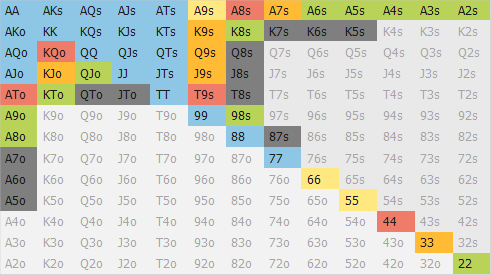
The best way to exploit this is to wait for above average spots where you
can shove. Never flat call bets or make raises for less than all
of your stack. Aside from your chip stack not giving you room to
play post-flop, you should attempt to capitalize on the little
bit of fold equity that you do have.
Short stacking in tournaments is no more complex than understanding that you have two
options: shoving or folding, and that you need to still hand
select a bit above average hands so that you can get your money
in with better than a coin flip. Of course, sometimes this plan
will flame out, but it’s what you should have in mind if the
opportunity should arise where you can put it into play.
Short Stacking Cash Games
The best piece of advice when it comes to short stacking cash
games is: DON’T DO IT.
Even the best short stackers are working
with very small win rates. If you do want to short stack in cash
games, you’ll need to be prepared for an awful lot of
variance. You are going to be up and down many buy ins over and
over again.
For all intents and purposes, you are going to be
playing out the 60/40 scenario on repeat. The problem is that
your 20% edge can take a long time to
balance itself out. As was the case with tournament short
stacking, cash game short stackers will also be playing a
push/fold game. There’s a very systematic approach to how to
best use this strategy depending upon your game of choice, and
this would take several pages to cover. In the end, though, your
most profitable plan is to not short stack at all.

If you learn how to play with a normal sized or deep stack, you’ll make a
lot more money in the long run. Short stacking is nothing more than
the easy way out for those who don’t want to actually become
good at poker.