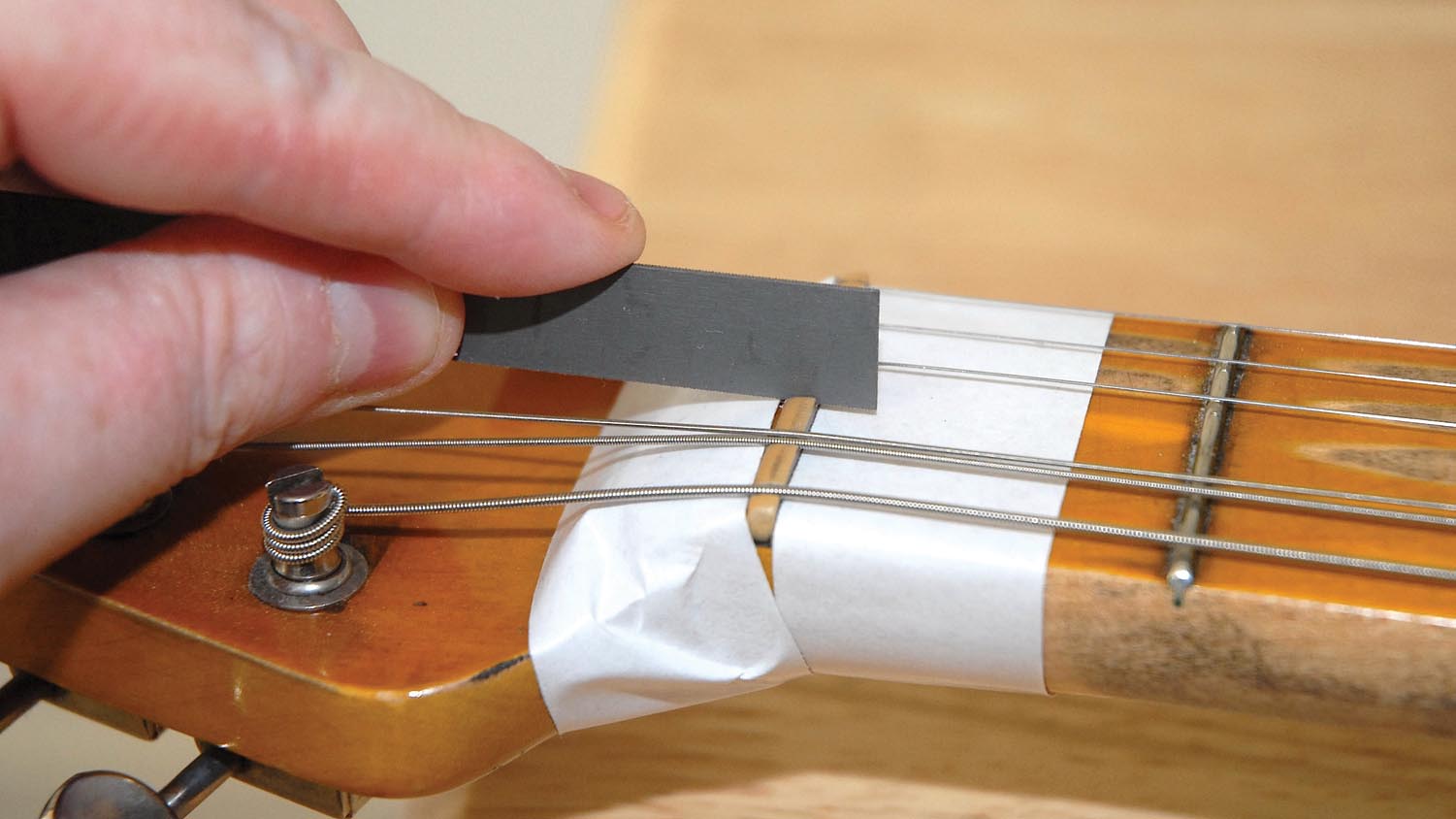
Pre-slotted Replacement String Nut for Strat/Tele Guitars - Black. Grover Perfect Guitar Nut - Height Extender Die Cast Zinc 3/8' Guitar Nut Height Extender with 11/32' String Spacing - Fits 1 7/8' Nut Widths $5.99. The depth and spacing of each string slot can make or break a guitar or bass. Lesser guitar nuts will often bind. You may even use wounded strings to file the nut with. Use a low E-string for the A nut slot, an A-string for the D nut slot and so on. If the nut slot is too tight and narrow, i.e. You are using thicker strings than the nut s used to, your guitar will get out of tune when you’re using the vibrato or when bending and shaking strings. John Carruthers shows us the proper way to adjust the Nut on a Stratocaster. This video is step 3 of a 4 part series. Videos include adjusting the Truss Ro. I show you how I go about filing the nut on an electric guitar to lower the action and get open chords to play more in tune.Website: http://www.lukemerwin.co.
Nut slots...with principles that apply, as appropriate, to bridge slots as well
Here's a gnat's-eye view at the face of a nut as seen from the leeward side of the second fret. The slots for these two strings are cut so that they completely support the string.
The sketch above relates to fretted instruments, but the basic principles are no different for violin family and other unfretted instruments. I'll try to explain the clearance in a minute.
Here's an idea of how it works on a bass:
Having the slot cut too high above the frets (or an unfretted board of some type) means that the act of pressing the string down to the first few frets actually stretches the string, raising the pitch and throwing the intonation off in the process. Ideally, the nut slot height is identical to any other fret. But remember that strings can 'saw' themselves through a nut just through normal use. I ordinarily leave a nut slot a little higher than necessary at first, to allow for the string to cut itself a little lower. I also avoid synthetic and elephant ivory, both of which are too soft and rubbery to make good nuts for steel strings.
Here's a shimmed-up mess of a nut that has all the problems:
These slots are all too deep, but the B is still so high it doesn't play in tune, so someone shoved a piece of ebony under it to try and correct the intonation. Big 'Ugh' for this one.
People often comment on certain strings (e.g., mandolin A strings, guitar G strings) being more troublesome, always seeming to go out of tune during play. Mandolin A's are always the most troublesome because they have to make compound bends from the nut: back as well as to one side. And the length from the nut to the post being the other important factor. And being plain strings, they tend to bind if the slots aren't cut right. (The D's, being wound, tend to refine their own slots.)
When you tune, you always tune up to a note, never down, right? Right.
It's about friction in the slot.
And with a poorly cut nut, when you tune up, the tension on the length of string between the nut and the string post is greater (per unit of length) than the part you actually play, that's between the nut and the bridge. After getting the pitch just right, a bit of actual playing works the string, making the tension on both sides of the nut equalize, and voilà: you're out of tune in mid-phrase. It has nothing to do with the tuning machines, which people just love to blame, but everything to do with setup, particularly how precisely the string slots at the nut are cut.
A quick word about creaking guitar G strings: this issue is fading as elephant ivory nuts are fading. Bone is superior to ivory for a nut material because it's harder and burnishes better. Ivory is soft and actually registers the imprint of string windings. That irritating creak is the sound of the windings skidding over grooves impressed inside the nut slot. Once again: setup is everything. (You can resurface string slots in an ivory nut by inlaying bits of with pearl or bone, if you like.)
How do you easily determine the ideal height of the string slot in the nut? OK, start with ⓵:
The string is a superb straightedge when it's under tension. This assumes the frets are really true and level.
The sketch below illustrates how - and how not - to shape a slot for any string.
Left: like the messy nut above, the nut material is too high. You need only enough to support half the diameter of the string. Anything more is just in the way. When the string is way below the top of the nut, you have great difficulty telling whether it's seating properly.
Next: a slot that's cut with a saw has a roughly flat bottom and also affords poor acoustic coupling. Saws seldom match the precise width of the string, which can roll side to side in the slot.
Next: strings will work their way down a v-cut, often bottoming out on frets (or the board, as the case may be with fretless instruments). The signal transfer is compromised because of the limited contact, and the string sizzles on the fret or the board. They also tend to bind and squeak. They can ruin your day.
Right: the slot really fits the diameter of the string, the nut material does not go above the halfway point of that diameter, and leaves the string a trace of clearance above the fret or the unfretted board surface.
How much is a trace? I'm reluctant to assign a measurement—it's very little. You can still see a bit of light.
If you hold any string down on any fret of a well set up instrument, you'll see that same preferred clearance at the next fret up.
Before going further, here's how to correct a string slot that's too low. Often it's wiser to repair a blown slot than it is to replace the whole nut.
Quick fixes like some kind of dust (bone, acrylic, baking soda) with superglue are really temporary. It takes little more effort to implant a little patch of bone (or even pearl) into the nut and recut the slot. It's as good as the original, and if done well, is quite invisible.
I have a couple of saws I use for widening and deepening in preparation for an implant. One is a fine hacksaw blade in a short handle, which is for wider strings. It leaves a nice flat-bottomed slot. The other is a backsaw such as one would use for cutting fret slots, which does the same and is good for finer strings. Avoiding hitting the first fret, assuming there is one, I cut down below the blown slot, sometimes almost to the board itself, angling the saw back a bit. Then I prepare the piece of bone (or whatever: ebony for a violin or cello) by carefully filing a piece of the material with a fine flat file until it slips snugly into the slot. I usually use old saddle scraps for this. A drop of CA and a tap and it's in there:
Trim and dress the nut as if it was new and uncut, then cut the new slot.
The slot itself needs to be shaped in a way that it not only fits the diameter of each individual string, but also such that the string has firm contact with the nut at the very front of the slot. This defines the end of the vibrating string length, and if it's not right, intonation will be impaired at the very least, and you may well find your string sizzling like a sitar string.
I prefer to shape my slots in the shape of a horn's bell:
The point of this is to offer a smooth surface for the string to travel from the tuning machine to the critical point of final contact at the front of the slot, where it is held firmly to define the end of the vibrating string length.
Strings have to make a compound bend at the nut, and to make tuning easiest while ensuring complete firm contact at the front of the slot, this horn bell shape makes certain the string glides smoothly, no matter the angle of approach. Here's a treble side view:
The bell here is imaginary. The nut is in yellow, the fingerboard is dark brown. The string is the green line, and the tuning machines are off to the right somewhere. Notice that the string connects with a smooth curved surface, no corner or edge. Whether the string is coming from the top or the bottom of the string post, it will slide smoothly into the nut slot. The string is in complete contact with the front 30% of the nut. There's plenty of substance there to keep the string from sawing its way deeper into the bone.
Here's the same slot seen looking straight down from above:
The string's other curve, from, say, the farthest peg on the bass side of the headstock, also elides with the inside of the bell-shaped slot, guided gently and directly to the front where it's held firmly by its own tension inside the confines of a well cut slot.
If the slot isn't properly angled back, several problems can arise.
If it's too flat (some repair books actually advocate this!) the string soon wears away the front of the slot and the functional point of contact is as much a 40% of the width of the nut back from the front edge, which can cause the note to ring poorly (because it's vibrating along a surface, not held to a point) and perhaps cause intonation problems. This is bad:
If the slot is angled back, but left a straight line, it will bind on the back edge, and the front edge will wear down from playing and the string is at risk for sizzling on the first fret or on the surface of the board. This is also bad:
The precise shape of the slot at the front edge is extremely important for sound quality, stability of the setup, and intonation.
More on bridges in due time, but the principles here apply to bridge slots on the viol and violin families, guitars, mandolins, and so on.
Here's a page on the files and so on you need to cut nuts.
Back to the repair index page.
This is a “top-down checklist” for the assembly of a solid-body electric guitar.
It can help you to build a guitar with specific sound and playability characteristics. Please read licence and the contribution guidelines before contributing.
Table of Contents
Sound and Playability Influencing Factors
| Component | Sound* | Playability* |
|---|---|---|
| Guitar Neck | + | ++++ |
| Guitar Body | + | ++++ |
| Guitar Electronics | +++ | - |
| Strings | ++ | ++ |
| Scale Length | + | + |
| Woods (Body, Neck and Fretboard) | + | + |
*influence ( “-” stands for little, “++++” stands for very strong)
For example, for building a solid-body ‘jazz-sounding’ guitar you have to choose (top down by importance):
- vintage or jazz pickup with convenient potentiometer and capacitor values
- flatwound strings
- massive neck, hollow body with wood such as mahagony
- shorter scale length
Guitar Necks
Neck thickness, neck width, neck contour and fret wire size affect playability and are a matter of personal taste. Important for good playability is balanced interaction of these components. Thicker neck often creates warmer tone.
usacustomguitars.com/necks - many neck shape and thickness combinations
musikraft.com - additional information for understanding of neck features.
Neck Profile
Neck Profile is the combination of contour (C, U, V , asymmetrc) and thickness (.0750' - 1')
| Contour | Thickness | Warmoth* | Fender* | Gibson* |
|---|---|---|---|---|
| D | thin | Wizard | D Shape | |
| C | thin/medium | Standard Thin | C Shape (AM Std) | Traditional C |
| C | medium | 59 Roundback | Deep C | Round C (1959 LP) |
| U | thick | Fatback | U Shape (Vintage Tele) | |
| V | thick | Boatneck | V Shape (Vintage 52 Tele) | |
| asymmetrisch | medium | Wolfgang | Modern C |
*warmoth - Warmoth Neck Profiles
*fender - see “NECK SHAPE” Filter
*gibson forum - Gibson Neck Profiles
Neck Nut Width and Nut Slot Spacing
| Category | Neck Nut Width | e1/E6 |
|---|---|---|
| Many Fenders from Japan | 41 mm (1-5/8') | approx. 34 mm |
| Standard | 42,9 mm (1-11/16') | approx. 35 mm |
| Acoustic analog | 44,5 mm (1-3/4') | 35 mm till 37,5 mm |
| Superwide (Warmoth) | 48 mm (1-7/8') | approx. 40 mm |
The real e1 to E6 string spread can be controlled not only through nut width, but also by slot spread in the nut. For example, 44.5 mm wide nut can have e1 to E6 distance between 35 and 37.5 mm.
| Category | String spacing | e1/E6 | e1 to edge | Neck nut width |
|---|---|---|---|---|
| Narrow string spread | 7 mm | 35 mm | 4.75 mm | 44,5 mm (1-3/4') |
| Medium string spread | 7.3 mm | 36.5 mm | 4 mm | 44,5 mm (1-3/4') |
| Wide string spread | 7.5 mm | 37.5 mm | 3.5 mm | 44,5 mm (1-3/4') |
Neck Heel Width and Mounting
Most guitar parts manufacturer adopted Fender’s® neck heel and neck pocket dimensions:
- 56 mm (2-3/16') - Width
- 76 mm (3') - Length
- 16 mm (5/8') - Pocket Depth
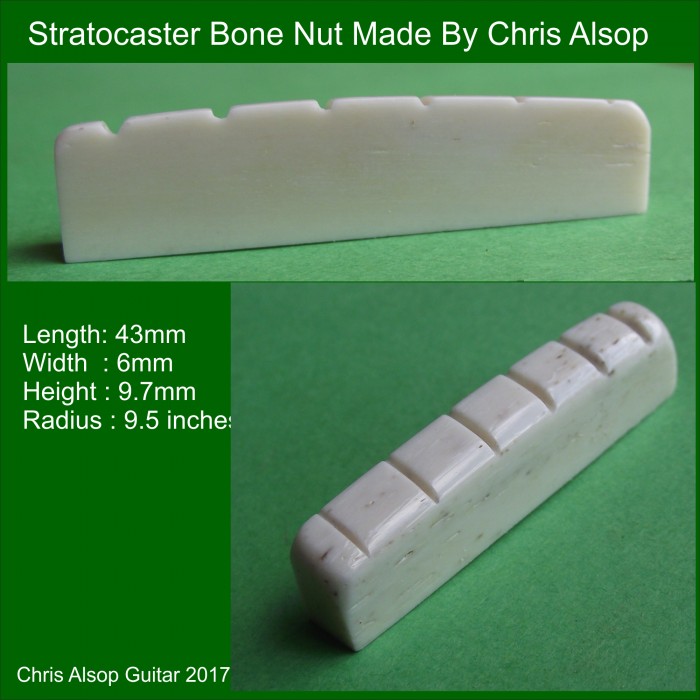
Stratocaster Nut Slot Height Chart
These dimensions are not a standard. Only careful measurement ensures that your parts will be compatible.
Strat necks have a rounded base to their heel and Tele necks have a squared-off base to their heel, which makes it difficult to interchange the two types of necks across various bodies.
Standard Fender heel mounting is done with 4-Bolt Holes - 1/8' (3mm) diameter (spread of 2' x 1-1/2').
Fretboard’s Radius
Smaller radius means a more rounded shape.
- 7-1/4' - “Vintage” Fender®
- 9-1/2' - “Modern” Fender®
- 10' - Gibson®/PRS®
- 12' - Ibanez®
- 16' - Jackson®
- compound (10' - 16') - Warmoth® and others
youtube.com - understring radius gauges - video demonstration of three different gauges used for guitar setup and fretwork: standard, notched and understring.
Fret Sizes
| Title | Width | Height | Example |
|---|---|---|---|
| Small | narrow | low | vintage Fender |
| Medium | narrow | high | many Martins |
| Medium Jumbo | wide | low | many Gibsons |
| Jumbo | wide | high | moderne Fender |
| High Jumbo | wide | very high | many Ibanez |
lutherie.net - provides an excellent manufacturer/sizes overview.
Common Neck Head Shapes
- 6L - Fender Style - left in line
- 6R - for left-handed
- 3L/3R - “Gobson Stype”
- 4L/2R - “Musicman Style”
Tuner Holes
- approx. 8,7mm (11/32') - “Vintage Fender Style”
- approx. 10mm (25/64' = 9,9mm) - “Sperzel Style”,
- approx. 10mm (13/32' = 10,3mm) - “Planet Waves Style”
- approx. 10mm on top and 8,7mm bottom - “Schaller/Grover/Gotoh Slyle”
Small holes can be enlarged with a sunk. Big holes can be retrofited by adapter bushings.
Guitar Bodies
The sound of electric guitar depends mainly on the vibration behavior of the string itself and the reproduction characteristics of the pickup. The vibration behavior of the string depends (very little) on wood. The body itself is very thick compared to the neck, that is why the body wood type and form have very limited influence on the sound of electric guitar.
music.stackexchange.com - how much does electric guitar’s body physics affect the tone and playability.
Body Shapes
The shape of an electric guitar can historically be divided into the following categories:
- ST (Strat)
- T (Tele)
- Single Cut (LP)
- Double Cut (SG)
- Hollowbody
- Other Forms
Bridge And Pickup Routing Overview
- Flat Mount Hardtail (Strat/Tele/Schaller)
- Tremolo (Strat)
- Tune-O-Matic (Gison)
- Other (Jazzmaster®, Jaguar®, Bigsby®, Kahler®, Line 6, etc)
Picture left to right:
- American Standard Tremolo Routing and Single Coil Strat Pickup,
- Vintage Telcaster Routing and Single Coil Tele Pickup,
- Tune-O-Matic Style Routing and Habucker Pickup
Flat Mount Strat Routing
Stratocaster Nut Slot Height Dimensions
| Model | E/e | Sites holes Ø | Sites holes distance | Bridge hole Ø | Bridge holes distance |
|---|---|---|---|---|---|
| Strat Vintage | 57 mm (2 1/4') | 3.18 mm (0.125') | 10.5 mm (0.413') | 3 mm (1/8') | 21 mm (.827') |
| Strat Vintage Narrow | 54 mm (2 1/8') | 4.78 mm (0.188') | 10.5 mm (0.413') | 3 mm (1/8') | 21 mm (.827') |
| Strat Standard | 52.83 mm (2.08') | 3.18 mm (0.125') | 11.3 mm (0.446') | 3 mm (1/8') | 22.6 mm (.89') |
Flat Mount Tele Routing
| Model | E/e | Sites holes Ø | Sites holes distance | Bridge hole Ø | Bridge hole distance |
|---|---|---|---|---|---|
| Tele Vintage | 54 mm (2 1/8') | 3.18 mm (0.125') | 10.9 mm (.429') | 3 mm (1/8') | 21.6 mm (.85') |
| Tele Standard | 54 mm (2 1/8') | 3.18 mm (0.125') | 10.5 mm (0.413') | 3 mm (1/8') | 32.4 mm (1.267') |
Flat Mount Schaller Routing
| Model | E/e | Bridge hole Ø | Bridge holes distance | Dimensions (LxWxH) |
|---|---|---|---|---|
| Schaller 47X | 51 mm - 55,5 mm | 3.18mm (0.125') | approx. X | 73 x 49 x 12(15) mm |
Tremolo Routing
| Modell | E/e | Holes | Hole Distance | Hole Ø |
|---|---|---|---|---|
| Mexico Strat | 52,4 mm (2 1/16) | 6 | 52,4 mm (2 1/16) | 3 mm (1/8') |
| Vintage | 56,36 mm (2 7/32') | 6 | 55,9 mm (2.2') | 3 mm (1/8') |
| American Standard | 52,83 mm (2.08') | 2 | 55,9 mm (2.2') | 9,5 mm (.375') |
| Floyd Rose (“recessed”) | 53 mm (2-3/32') | 2 | 74 mm (2.913') | 9,91 mm (.390') |
| Schaller 2000 | 53,5 mm | 2 | 56 mm | 10 mm |
| Schaller vintage | 53,5 mm | 2 | 74,3 mm | 10 mm |
| Wilkinson (“recessed”) | 54 mm (2-1/8') | 2 | 55,9 mm (2.2') | 9,7 mm (.382') |
callahamguitar.com - technical specifications of some coustom parts.
Tune-O-Matic Gibson Style Routing
| Model | E/e | Bridge | Tailpiece | Tailpiece Top | Tailpiece Bottom | Tailpiece Ø |
|---|---|---|---|---|---|---|
| Tune-O-Matic | ca. 52 mm* | 74 mm (2.91') | approx 82 mm* | 38 mm (1.49') | 41 mm (1.61') | approx. 11 mm (0.44') |
Instead Tailpiece - there may be “strings through the body” drillings.
Other Rare Bridge Variants
- Wrap-Around (bridge-tailpiece combo - the strings are installed through the front side and wrapped around)
- Jazzmaster®
- Jaguar®
- Bigsby®
- Kahler®
Pickup Routing
- Single Coils (Strat)
- Single Coils (Tele Neck)
- Single Coils (Tele Bridge)
- Humbucker
- Wide Humbucker *
- Mini Humbucker
- P90
- Lipstick Tube
- Jazzmaster
*Wide Humbucker (same as Seymourduncans “Trembucker” or Dimarzios “F-spaced Hambucker”) can be used for guitars with larger sting distance with standard “Humbucker Routing”. Measure from the middle of the high string to the middle of the low string, directly over the pickup. If the distance is greater than two inches or 50mm, go for a Wide Humbucker.

Exact specifications can be found on the manufacturer’s website like:
bareknucklepickups.co.uk - dimensions
In addition to classic HH routing (2X hambuckers), there are the following variants: - SSS (Strat, Nashville Tele)

- HSS (Strat Humbucker im Steg, Modern Player Tele)
- HSH (Strat),
- HS (Strat, 72 Tele)
- SS (Tele),
- HP90 (Yamaha Pacifica),
- S (Tele Esquire),
- and some other exotic combinations
Tuning Machines
Tuning Machines Options:
- Configuration: 3L+3R (Gibson style), 6-in-Line (Fender style), 4L/2R (Musicman style)
- Diameters of bore holes for axis (see chapter Tuner Holes)
- Ratio - for 1x winding around the shaft head - 1x rotation necessary.
Larger ratio (1:18 > 1:14) allows finer adjustments. - Standard vs Locking - with locking tuners strings are inserted through the axle bore and fixed by a screw from the outside
Bridges
Guitar bridge has large influence on playability (mainly through string spacing). Wider string spacing is better for finger-picking style, narrow spacing gives easier control when playing leads with distorted tone. Bridge Routing chapter above describes common bridge categories with string spacing specification.
Bridge form and material have also some influence on sound.
Good manufacturers provide detailed product information on their pages:
ABM - indicates that Bell Brass and Steel shape the guitar sound with character, while Aluminum acts largely neutral in the transfer of tone.
Hardware Parts Checklist
- Jacks & jackplates
- Neck plate (neck-to-body)
- Pickguard or pickup mounting rings
- Screws for all parts above
- Control plate (only for for standard tele)
- String ferrules (String-thru Top or Bottom - if you use “string through body” instead of bridge)
- String retainers. Happy Little String Trees
- Strap holders
For each screw, the hole must be pre-drilled to the core diameter (not outer diameter)
Electronics
Electronics exerts greatest influence on the overall sound of a solid-body electric guitar.
buildyourguitar.com - The Secrets of Electric Guitar Pickups by Lemme - “If you know the resonant frequency and height of the resonant peak, you know about 90 percent of a pickup’s transfer characteristics. Some other effects cannot be described using this model, but their influence is less important”.
Frequency response of a magnetic pickup may look like this
| Sound group | Resonant frequency | Resonant peak | Example Pickup |
|---|---|---|---|
| bright | 3 - 6kHz | high peak | Fender single coils |
| powerful | 2 - 3kHz | medium high peak | Gibson PAF |
| mellow | 1.5 - 2kHz | low peak | Rolling back tone pot |
Following topics change resonant frequency and resonant peak:
- Pickup Properties - position and height of frequency peak vary from type to type.
- Electronics Wiring Options - Hambucker coils are switched in series by default, switching them in parallel or using only one of the coils will increase resonant frequency and the sound will have more treble.
- Potentiometer and Capacitor Values changing provides also simple way to change resonant frequency and peak.
- Cable capacitance - longer cable will lead to lower resonant frequency.
- Amp input impedance
Pickup Properties
- Dimension and product group - see chapter Puckup Routing
- Wiring: 1, 2, 3 or 4-Conductor (4-Conductor allowing most flexible wiring)*
- Position: Bridge, Neck, Middle
- Symmetrical vs asymmetrical connection type
- Output: low(vintage), medium, high (vintage used often for jazz and blues)
- Passive vs. Active (Active often used for distortion sound)
- D.C. Resistance: indication how much output a pickup will have
- E.Q. chat: A general idea as to the Bass, Mids and Treble.
seymourduncan.com - pickup selector
dimarzio.com - pickup picker
Classic humbuckers are asymmetrical. They are internally wired in series (i.e. serial - brings more power) in opposite phase (less noise). The current multi-Conductor PUs offer the option of switching the coils differently using push / pull pots, mini switches, toggles, mega switches and rotary switches, and allow broad control over the sound directly on the guitar.
| Conductors | Connection Type | Coil Split | Seriell/Parallel | Phase Switch | Example |
|---|---|---|---|---|---|
| 1x | Asymmetrical | Humbucker Mode | Seriell | No | Shadow AZ48 |
| 2x | Symmetrical | Humbucker Mode | Seriell | Yes | Fender Wide Range (Mexico) |
| 2x | Asymmetrical | Humbucker & Single Coil Mode | Seriell | No | Benedetto B6 |
| 3x | Symmetrical | Humbucker & Single Coil Mode | Seriell | Yes | viele aktive PUs |
| 3x | Asymmetrical | Humbucker & Single Coil Mode | Seriell and Parallel | No | PRS 59 |
| 4x | Symmetrical | Humbucker & Single Coil Mode | Seriell and Parallel | Yes | all 4-Conductor PUs |
Sound Control with Switches
| Switch | Coil Split | Seriell/Parallel | Phase Switch | PU switch |
|---|---|---|---|---|
| Toggle Switch | - | - | - | y |
| Blade Switch “Fender” | - | - | - | y |
| X-Way-Blade “Megaswitch” | y | y | y | y |
| Mini-Switch SPDT(ON/ON) | y | - | - | - |
| Mini-Switch SPDT(ON/OFF/ON) | y | - | - | - |
| Mini-Switch SPDT(ON/OFF/ON) | y | - | y | - |
| Mini-Switch DPDT(ON/ON) | y | y | y | - |
| Push/Pull-Pot DPDT(ON/OFF/ON) | y | y | y | - |
| Mini-Switch DPDT(ON/ON/ON) | y | y | y | y |
| Drehschalter | y | y | y | y |
- Coil Split - “Single Coil Sound”
- Seriell/Parallel Schaltung - “double Single Coil Sound”
- Phase-Switch - “Out of Phase Sound”
SP = Single Pole, DP = Double Pole, DT = Double Throw
Example: “Seriell/Parallel und Coil Split at same time” are possible with 4 Push/Pull Pots, 4 Mini-switches (i.e. duncan triple shot) or by 5-Way Blade Megaswitch
open.guitars (german) - Hambucker Conductor/Coils switching options.
Electronics Wiring Schemas
More wiring schemas from:
Potentiometer and Capacitor Values
| Sound group | Pot | Cap | Examples |
|---|---|---|---|
| standard hambucker | 500K | 0.047mF | most hambucker equiped guitars |
| bright | 500K | 0.022mF | some guitars (U.S. FAT Tele) |
| brighter | 500K | 0.01mF | some custom models |
| brightest | 1M | 0.01mF | some custom models |
| standard singele coils | 250K | 0.022mF | most strat & tele models |
| jazzy | 250K | 0.047mF | some teles (ASAT BluesBoy) |
http://www.planetz.com/guitar-tone-capacitors-material-types - comparison of tone capacitor material types and capacitance values.
Volume and Tone Potentiometer Options
| Group | Pot body Ø | Bushing Ø | Bushing length | Shaft length | Example |
|---|---|---|---|---|---|
| standard | 24 mm | 8 mm | 10 mm | 19 mm | most fender guitars |
| mini | 17 mm | 7 mm | 10 mm | ‘>’ 17 mm | many jazz guitars |
| long | 24 mm | 8 mm | 20 mm | 27,5 mm | most Gibson LP guitars |
- Resistance: 250K, 300K, 500K, 1M
- Taper: Audio, Reverse Audio, Linear, Balance
- Shaft Type: Knurled, Round & Plain
- Shaft Diameter: 6 mm (0.236 in), 6.35 mm (0.25 in)
- Shaft Length: 17mm, 19 mm (0.75 in), 27,5 mm (1.125 in)
Potentiometer Knob Styles
There are 3 common styles of knobs:
- bell
- speed
- domed
philadelphialuthiertools.com - Choosing the correct knob for your guitar or bass.
Active Pickups Electronics
Active Electronics tries to reduce dependancy from the shielded cable and amp input impedance. However, that needs power to operate, and that’s its biggest drawback.
Custom Buffers (german) - used to decouple the guitar electronics from the sound influencing effects on the shielded cable.
Strings
Depending on following options your sound will be more bright or more mellow:
- Construction (Flat Wound/Round Wound)
- Material (Steel/Nickel) and
- Tension
Most manufacturers use following naming convention to describe tension of string set:
| Name | ‘e’ site approx. | ‘E’ site approx. |
|---|---|---|
| Extra-Light | .008 | .039 |
| Light | .009 | .042 |
| Regular | .010 | .046 |
| Medium | .011 | .052 |
| Jazz | .012 | .054 |
| Baritone | .013 | .056 |
There are also other hybrid sets available - like “Light Top/Heavy Bottom” and “Balanced Tension” combinations.
daddario.com - you can choose between bright and mellow sounding electric strings.
ghsstrings.com - also bright vs mellow overview, and tension guide (pdf)
thomastik-infeld.com - good jazz and blues strings
Scale Length
A guitar’s scale length is length of string between the nut and the bridge.
Scale has a relatively low impact on sound and playability of the guitar. (Compared with other parameters such as strings or pickups).
Longer scale length sound and playability characteristics:
- quick response, crisp attack
- transparent sound with well-defined basses and heights
- larger finger spread
- higher string tension at constant gauge
Shorter scale length sound characteristics:
- warmer
- more sustain and longer decay
Common Scale Length:
- 572 mm (22.5') or shorter - 3/4 & some travel guitars
- 596,9 mm (23.50') - Fender Jazzmaster/Jaguar guitars
- 629 mm (24.75') - many Gibson guitars
- 635 mm (25') - many PRS guitars
- 648 mm (25.5') - many Fender guitars
- 650 mm (25.5) - typical classical guitars
- 686 mm (27') or longer - Baritone guitars
Woods
| Woods | Sound¹ | Weight² | Used for³ | Looks |
|---|---|---|---|---|
| Alder | bright | medium | T/B | bright, simple |
| Ash | bright | medium | T/B | bright, simple |
| Basswood | neutral | light | B | bright, simple |
| Bubinga | bright | medium | T/B/N/F | red, often grained |
| Ebony | bright | heavy | N/F | dark |
| Maple | very bright | heavy | T/B/N/F | bright, often grained |
| Koa | warm | medium | T/B/N | dark, grained, attractive |
| Korina | warm | medium | T/B/N | grained, attractive |
| Mahogany | warm | medium | T/B/N | red |
| Poplar | neutral | medium | B | bright, simple |
| Rosewood | warm | medium | T/B/N/F | dark |
| Sitka Spruce | neutral | light | T/B | bright, simple |
| Swamp-Ash | neutral | light | T/B | bright, attractive |
| Walnut | bright | medium | T/B/N | gray, attractive |
| Wenge | bright | heavy | T/B/N/F | dark |
¹ Sound: the diagram for effects on tone stands mainly for acoustic instruments and NOT for solid body guitars, where other components have much larger impact on sound. Thus, a mahogany electric guitar can sound bright despite the representations below.
² Weight may vary for the same variety.
³ Used for: T - Body Top B - Body N - neck F - fretboards
frudua.com - graphical examples for body and neck woods showing relationship between wood hardness, its density and tone.