What are Pot Odds In Texas Holdem Poker?
- Texas Holdem Opening Hands Chart
- Texas Holdem Hands Odds
- Texas Holdem Opening Hands Odds Today
- Texas Holdem Hands Odds Chart
A player’s pot odds refers to the ratio between how much they can win and how much they must invest when they are facing a bet. So in a no-limit game, if player A were to bet $100 into a $100 pot, then player B would be facing pot odds of 200:100 which should be simplified to 2:1. Alternatively, a bet of $50 into a $100 pot would offer odds of 3:1, and a bet of $200 into a $100 pot would provide pot odds to the caller of only 1.5:1. In order to calculate your pot odds, you simply put the bet and the size of the pot on the left side of the colon, and you put the bet on the right side, ie pot + bet : bet.
Click Here to Learn the secrets to playing Texas Holdem poker from a pro in this video!!
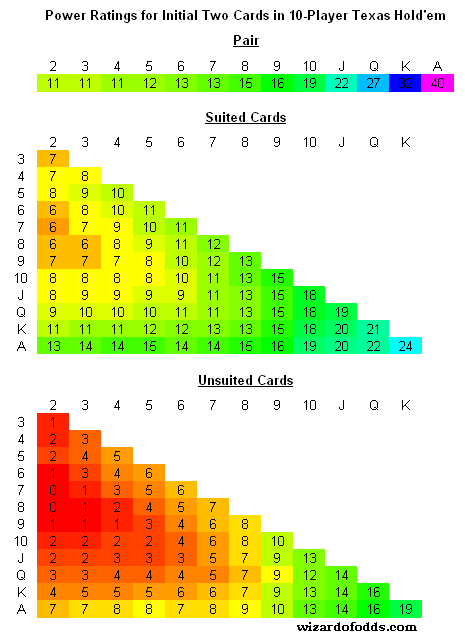
Poker Hand Rankings - Texas Holdem Starting Hands Chart. At the bottom of this page is a comprehensive listing of Texas Hold'em starting hands based on their EV (expected value). Expected value is the average number of big blinds this hand will make or lose. Playing poker is about playing the odds. The following list gives the odds for outcomes in Texas Hold’em hands. When you realize how heavily the odds are stacked against you, you may want to rethink going all-in before the flop with two suited cards. Use the odds to your advantage: 1 percent (1-in-100): Percentage of.
Are Pot Odds Important And How Do They Work?
Pot odds are very important, especially when it comes to calculating whether or not you should call on a draw. In order to determine whether or not it is profitable to draw, you simply compare your pot odds with the ratio of non-outs to outs. So for example, imagine that you have Qh2h on an AhKh4s flop. There is $60 in the pot, and your opponent bets $20. Should you call? Here it is easy to calculate your outs. There are nine hearts left in the pack. We know five cards (our two hole cards and the three community cards on the flop), so there are forty seven unknown cards. Of these, thirty-eight do not give us a flush and nine do (38:9). This can be simplified to 4.3:1 against improving on the turn. Our pot odds are 80:20 or 4:1. So here our pot odds do not quite justify a call, but because we are drawing to the nuts and the difference is quite modest we can rely on our implied odds to make up the difference.
Implied Odds In Texas Holdem Poker.
Implied odds refer to the fact that there are still bets to come. Looking back to our flush draw example, after calling the $20 on the flop there is still a turn and river to play. We could potentially make our flush on the turn, bet $70, get called, and then get called again for a large bet on the river. Or our opponent might simply fold once the flush comes in. Predicting the future is always a tricky thing to do, and that is part of the joy of playing poker.
Here Is A Great Example Of Texas Holdem Poker Hand Odds .
The first three players fold, and then mid-position (MP)+1 raises to $7 in a $1/$2 game. You flat on the button with 6s5s, and the big blind comes along as well. There is $22 in the pot. The flop then comes down as As2s7h. MP bets $20 and the action is on you. You are getting ever-so slightly better than 2:1, and like 9 cards on the turn, so your odds of improving are again 4.3:1 against. Here there is a very large disparity between your pot odds and your implied odds. The situation is also significantly worse in two additional ways. Firstly, and most importantly, you are drawing to a six high flush that is not at all the nuts. Secondly, you are not closing the action. The problem with drawing to a six high flush (especially in a multiway or mass multiway pot) is that it is very easy for someone else to have a better hand. In poker, you want to be very cautious about drawing to non-nut holdings (see poker winning hands for the nuts). And the problem with not closing the action is that the player in the big blind could still raise, which means your effective pot odds are reduced. Because of all these factors (we aren’t getting the right price, we might be drawing dead, and there is still another player left to act who could raise causing us to forfeit our call) the best play is to simply fold. In fact, we probably shouldn’t have called to see the flop in the first place, simply because our cards are too low.
How Important Are Your Texas Holdem Poker Hand Pot Odds?
Your pot odds inform many of your decisions in Texas Hold’em poker. Of course, but there are other factors as well. It is crucial to study your opponents and observe their tendencies to better appreciate the quality of their bets. But from a mathematical point of view, there are few things as fundamental as the concept of pot odds. For example, consider the idea of defending your big blind vs a 3.5x open and a min-raise. In example A, the button opens for $7 in a $1/$2 game, and the SB folds. In example B, the button opens for $4 in a $1/$2 game. Assuming that the button is opening at the same frequency in both examples, then we should defend much more liberally in example B, where we are getting 3.5:1, than in example A, where we are getting 2:1. Basically, because the pot odds are greater, we have less risk and more reward, so calling becomes more profitable. Essentially we only have to win the pot 22% of the time instead of 33%. And with higher pot odds and less invested to see the flop, our implied odds increase as well. Of course, we do face a positional disadvantage, which should temper our enthusiasm somewhat, but that can be mollified with accurate play after the flop.
When Should You Call Based On Texas Holdem Poker Hand Odds?
Another example where pot odds matter is in determining whether you should call or not on the river. The greater the pot odds the more liberally you should call. If there is $200 in the pot and your opponent bets $30, then you would be getting great odds and should likely call with any pair, or maybe even ace high. You only have to be right 1 in 7 times to show a profit. On the other hand against a larger bet, you should generally be a bit more cautious, unless you think that they are bluffing. Against a player who does not bluff (or bluffs at a low frequency), you would want to have a pretty strong hand to call a large river bet, one that would beat some or many of the hands that he is value betting.
Conclusion.
To progress in Texas Holdem Poker and make money in the long run you must understand pot odds and implied odds in order to understand when to call a bet. You need to take into account the size of the pot and the chips you need to throw in to make the call, against the cards in your hand and the chances of winning. If you don’t know the chances of winning, based on pot odds, you will never know if you should be calling or not. And its not just about the hand you are in right now, or even todays game, but it is based on the results of all the games you play over a season, a year, a career. If you want to come out ahead in the long run, you have to know the pot odds for the hands you are in. Sure, you can make a hero call now without the odds in your favor, and you might win today, but if you keep doing that over a multiple games, you will lose in the long run.
So sit down tonight at the poker table, take some time to consider the pot odds for each hand when you are on a draw, and fold or call appropriately. Good luck and see you on final table!!
More from my site
NL Hold’em Starting Hand Charts
One aspect of the game of No-Limit Hold’em that causes beginning players much grief is deciding which hands to play and which hands to dump. NL Hold’em is much more difficult than Limit Hold’em because the value of a hand depends on so many factors other than just the cards in your hand. Despite this difficulty, our coaches believe that following some general guidelines and adjusting from these is a better solution than having no guidelines at all. Given that well over half of your profitability in NL Hold’em is based on hand selection alone, we have developed these charts to help you better determine whether to play or fold.
There are no perfect No-Limit starting hand charts. That is because there are many factors that affect your decision, and charts cannot account for all of them. Some of these include:
- The size of your opponent's stacks.
- How loose or tight, passive or aggressive, your opponents are.
- Where these opponents are located at the table – for example, does an aggressive player still have to act after you?
- Your image at the table – for example, how tight or tricky you are perceived.
That being said, these charts will serve you well in most typical low-stakes No-Limit cash games, such as games with blinds of $1/$2, and home games. These games typically have several loose players at the table, and good opportunities for winning big pots with suited connectors and pocket pairs. With practice, you will be able to be a consistently winning player with these charts as a starting point. As you improve, you'll find yourself making adjustments to these charts based on the factors listed above, and more.
AGAIN: These charts are a good starting point for beginners. Specifically, Chart #1 recommends a significant amount of limping. This is great in loose, passive games but less often seen in tougher games. You’ll find other training material on Advanced Poker Training that may recommend a more aggressive approach for more experienced players.
Note: It would be a serious mistake to apply these hand charts before reading the Frequent Asked Questions first.
CHART #1 ‐ LOOSE, PASSIVE GAME (OFTEN 4-5 LIMPERS PER HAND)
NO ONE HAS RAISED YET
- Raise Always
- Call from Early Position, otherwise raise
- Call always
- Call from Middle or Late Position if the conditions are right (see Frequently Asked Questions)
CHART #2 ‐ TIGHTER GAME (FEWER LIMPERS) OR MORE AGGRESSIVE GAME
NO ONE HAS RAISED YET
- Raise Always
- Call from Early Position, otherwise raise
- Call (or Raise) from Middle or Late Position if the conditions are right (see Frequently Asked Questions)
CHART #3 ‐ THERE HAS BEEN A SINGLE RAISE
(3‐5 TIMES THE BIG BLIND) BEFORE YOU
- Re‐Raise Always
- Call from Early Position, otherwise re‐raise
- Call always
- Call from Middle or Late Position if the conditions are right (see Frequently Asked Questions)
FREQUENTLY ASKED QUESTIONS
For the hands in yellow, what do you mean when you say to play these hands if the conditions are right? The hands in yellow are speculative hands. They should always be folded from Early Position. From other positions, they can be profitable given the right conditions. Some of the questions to ask yourself:
- Are there other players who have called so far (the more, the better)?
- Are the players who have called playing poorly after the flop? Will they pay me off if I hit something?
- Is there an aggressive player still to act behind me (you might get raised and have to fold)?
- If there has been a raise and no other callers, what chance do I have of using my position after the flop to win the hand even if I don't improve (Chart #3 only)?
Why does Chart #2 say to sometimes raise with the hands in yellow, but Chart #1 does not? We have different goals in mind. Using Chart #1, we want to call to encourage additional players to enter the pot. These hands will be immensely profitable when our loose, passive opponents enter the hand, and get trapped when we flop a set, or make a well-disguised straight. When using Chart #2, however, we want to size up the opponents still to act. If they are tight, we can raise. Sometimes, we'll pick up the blinds. Other times, our pre-flop aggression will allow us to take down the pot on the flop.
What's the difference between AKs and AKo? AKs means an Ace and King of the same suit. AKo means an Ace and King of different suits.
What are early, middle, and late position? Early Position is generally the first 2 (in a nine player game) or 3 (in a ten player game) positions after the blinds. Late Position is the “cutoff” position (to the right of the dealer), and dealer button positions. Middle Position is everything in between.
How much should I raise? As a general rule, raise 3 to 4 times the big blind, plus 1 extra big blind for every player who has called before you. So if there are 2 callers already, raise between 5 and 6 times the big blind.
What if someone raises after I call? Whether you call the raise depends on how much money the raiser has for you to win, how many other players are involved, and what type of hand you have. As a general rule, if you have a pocket pair, lean towards calling. If there are a lot of other players (and therefore a big pot), lean towards calling. In general, fold suited connectors from early position. Fold hands like KQ that don't play well against a raiser.
Texas Holdem Opening Hands Chart
How do I play from the blinds? From the small blind, play the same hands you would play from late position, plus a few more. But don't call with junk hands like T5o, just because it is “cheap”. From the big blind, if there is a raise to you, play like you would if you had already called from early position.
Texas Holdem Hands Odds
The chart says to fold KQo to a raise. Really? Yes, this hand performs very poorly against typical raising hands. Against AK, AQ, AA, KK, QQ, you are a big underdog. Other typical raising hands like JJ, TT, 99, AJs, are slightly ahead of you as well. The only time you might call or re-raise is from late position, if the opener was in middle or late position, indicating they might have a wider range of hands.
I was told to fold AJo from Early Position, why do you say to call with it? Folding AJo is not a bad idea in many games. We included it because, at low stakes tables (even tight or aggressive ones), the players are often playing badly enough after the flop that it can be profitable. We used data from millions of hands of low-limit poker to analyze this. The same could be said for KQo, ATs, and KJs – you can make a small profit in the long run at most low-stakes games, but folding would be perfectly acceptable from early position.
Can I use these charts in a NL Hold'em tournament? The charts would be best applicable to the early stages of a NL tournament, when everyone has a deep stack. In the middle and later stages, they should not be used.